
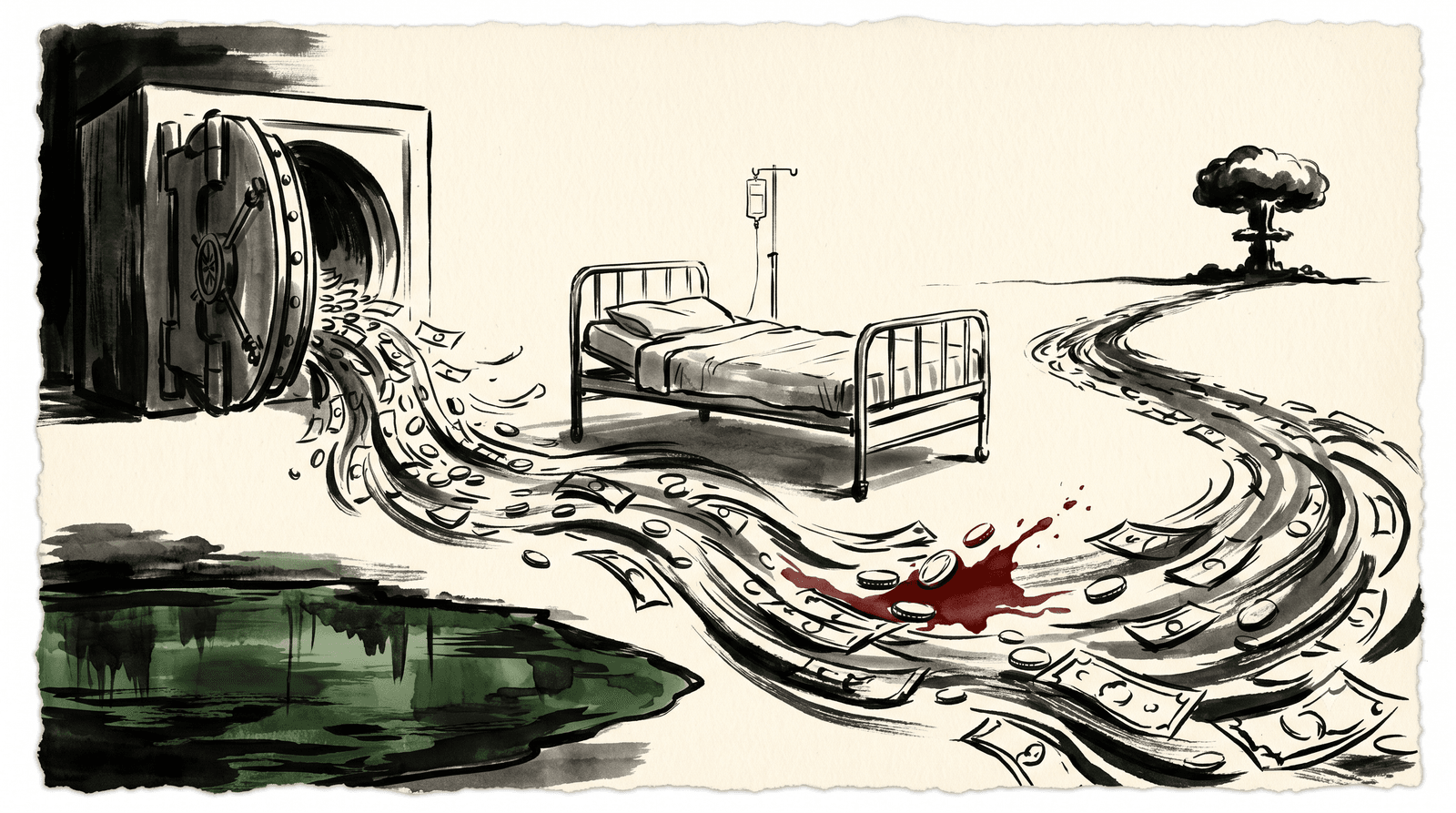
An ink-wash illustration of an empty hospital bed beside an overflowing vault, the money pouring out toward a distant war and a green puddle.
We Can Afford Everything but You
We're told universal healthcare is a fantasy the country can't afford — right after conjuring a $300 billion fund to rebuild the nation we just bombed and $14 million to paint a reflecting pool that promptly turned green. Here's the math they'd rather you never do.
Let’s start with a number, because the entire con depends on you never quite seeing it: $4.9 trillion. That’s what the United States spent on health care in 2023 — about $14,570 for every man, woman, and child in the country, or 17.6% of the whole economy [1]. We spend more, per person, than any nation that has ever existed, and in exchange we die younger than our peers and go broke doing it. You are not getting a discount for the chaos. You are paying a premium for it.
Now your slice. If you get coverage through work — most of us do — the average family plan ran $25,572 a year in 2024, of which you personally surrendered about $6,296 before a single deductible, copay, or “sorry, that doctor’s out of network” [2]. By 2025 the family number had crossed $27,000 [3]. That’s a used car. Every year. For the privilege of arguing with a call center about whether your kid’s inhaler counts.
So what would the alternative — real universal coverage, everybody in — actually cost? Here’s the part they bury. Even the Mercatus Center, a libertarian shop in the Koch orbit and no friend of single-payer, ran the numbers and produced a scary headline: roughly $32.6 trillion in new federal spending over ten years [4]. Terrifying — until you read the very next line of their own study, which found the nation’s total health spending would come out roughly flat, even slightly lower, than the path we’re already on [4][5]. A Yale-led team in The Lancet went further: universal coverage would save about $450 billion a year and prevent roughly 68,000 deaths annually [6].
Read that difference slowly, because it is the whole ballgame. The choice is not “expensive new system” versus “cheap current one.” We already pay for a universal-scale system; we just don’t get universal coverage in return. That “$32 trillion” isn’t money summoned from the void — it’s mostly the premiums, deductibles, and copays you already hand over, rerouted from an insurance executive’s bonus into a tax that, for most households, would be smaller than the premium it replaces. You already bought the Ferrari. They just won’t let you sit in it.
So when someone in power tells you we “can’t afford” to keep Americans from dying over insulin, understand that it was never a math problem. It’s a priorities problem. And this month handed us two gleaming illustrations of exactly what those priorities are.
Exhibit A: $300 billion for the country we just bombed
We just wrapped a twelve-day shooting war with Iran — the one the President insists ended in an “unconditional surrender,” a surrender so total it came with a 60-day negotiating window and, it turns out, an invoice. According to Reuters, the framework deal includes a $300 billion “Reconstruction and Development Fund” to pour capital into Iran’s energy, logistics, manufacturing, and transport sectors — and more than half of it, over $150 billion, is already committed [7].
Now, credit where it’s due: the administration swears not one dime is American taxpayer money — it’s a private fund, backed by companies from the Gulf, Asia, and, yes, the United States [7]. Fine. Take them at their word — leaked documents and the President’s “fake news” denials make that awfully generous, but fine. Whose name is on the check isn’t the point. The speed is the point. Iran asked for $400 billion in war reparations; we said absolutely not — and then, within days, $300 billion in capital assembled itself to rebuild the very country we’d been bombing the week before [7].
Sit with the arithmetic. $300 billion is roughly the annual health-insurance premium for eleven million American families [3]. When the will exists, the money is instant. It materializes overnight for pipelines in a nation we just called the enemy. It is only ever “impossible” when the person who’d benefit is you.
Exhibit B: $14 million for a puddle
If the Iran fund shows how fast money moves when the powerful actually care, the Lincoln Memorial Reflecting Pool shows what they care about. The administration spent more than $14 million renovating it — including repainting the floor a shade the President personally christened “American flag blue” [8].
It did not go well. Refilled, the pool promptly turned green — a textbook algae bloom scientists say was likely worsened by the renovation — and the fresh paint began to peel, which experts trace to the government’s own cleanup crew dumping hydrogen peroxide in the water, where it acted as a paint stripper [8]. Confronted with a $14 million puddle of his own making, the President did the presidential thing: he blamed “vandals.” He described a phantom 250-foot knife gash and chemical sabotage, produced zero evidence, and his government managed to arrest exactly one suspect — a 67-year-old, three-time Olympian who says he was simply reaching down to fish a floating strip of peeling blue paint out of the algae [8].
There is the entire governing philosophy, in one stagnant pond: spend lavishly on vanity, botch it, blame someone weaker, and demand applause for the wreckage. And that $14 million — the cost of the puddle — is a full year of health coverage for about fifteen hundred Americans [3]. It’s sitting at the bottom of a green pool in Washington, and they’d like you to know it was definitely the Olympian’s fault.
We could do this easily — with leadership that had half a brain cell
Here’s the truth that ought to make you furious: covering everyone is not a moonshot. It’s an accounting decision we keep refusing to make. We already spend the most on earth [1]. The Mercatus study its own authors hoped would bury single-payer instead found it would wring out about $1.6 trillion in administrative waste and $846 billion in drug costs over a decade — simply by letting the government negotiate prices and stop funding the paperwork-industrial complex [4]. Every other wealthy nation covers everyone for less than we pay to cover some of us.
And the impact on you would be — I cannot stress this enough — minimal, and mostly good. Your premium becomes a tax that’s smaller than your premium. That “employer contribution” — the roughly $19,000 a year your boss pays toward the family plan, which is really just your own wages taking a detour — comes home to your paycheck [2]. Deductibles, copays, networks, surprise bills, prior authorizations, and the entire genre of American horror story that opens with “then we got the envelope from the hospital” — gone. The only people who lose are the middlemen whose whole business model is standing between you and your doctor with a clipboard and a denial stamp.
What’s missing isn’t money, or a model, or evidence. What’s missing is leadership with half a functioning brain cell — the kind that can locate $300 billion for Iran’s transport sector and $14 million for a flag-blue puddle, but goes slack-jawed when you ask it to keep a diabetic out of bankruptcy.
”But the quality will crater and the waits will explode”
Here comes the next reflex, and it always arrives as a story, never a statistic: my cousin in Canada waited eight months for a hip — you want that here? Maybe your cousin did, and I’m genuinely sorry. It is also a single anecdote, and an anecdote is not a data set. One bad meal doesn’t make a restaurant the worst in town; one long wait in one underfunded system doesn’t tell you what universal coverage does on average. So let’s do the boring thing the fearmongers won’t, and look at the average.
Would the quality of care drop? Drop from what, exactly? Among the wealthy nations, the United States already finishes dead last in overall health-system performance — last on access, last on equity, last on outcomes — while paying the most by a country mile [12]. We have the lowest life expectancy and the most avoidable deaths — people who would still be alive in Australia or the Netherlands — of any rich country [12]. You cannot credibly panic that universal care would tank our quality when we are already standing at the bottom of the developed world holding the most expensive receipt. There isn’t much “down” left.
And here’s the structural fact nearly everyone misses: single-payer changes who pays the bill, not who holds the scalpel. Same doctors. Same hospitals. Same MRI machine. The only thing that vanishes is the middleman who currently stands between you and that machine with a clipboard and a denial stamp. We already run precisely this system for everyone over 65 — it’s called Medicare, and Grandma did not lose her doctor.
Would the waits get longer? Here’s the honest answer, because you deserve one. “Universal coverage” does not mean “Soviet bread line.” The countries with the worst waits — Canada, the U.K. — got there by underfunding their systems, not by covering everyone. The ones that fund it properly — Germany, the Netherlands, Switzerland — post shorter specialist waits than Canada and hold their own against us [13]. Waiting is a function of how many doctors and beds you pay for, not of whether the poor are allowed in the building.
And spare me the fantasy that America is some no-wait paradise. We already ration care — we just do it by wallet instead of by calendar. In 2022, a record 38% of Americans said they’d put off needed treatment because of cost [14]. That is a wait time too. It’s an infinite one, for the people who simply never go — who find the lump and pray instead of pay. We don’t see those waits, because they happen in living rooms, not waiting rooms.
So here’s the fully honest version, including the part the cheerleaders skip: yes, person to person, some of it could shift. If you carry a platinum employer plan and have never once thought about cost, you might — might — wait a little longer for an elective knee as the roughly 26 million people currently uninsured [12] finally walk through doors that were bolted to them — unless we also train and fund more providers, which, you’ll be stunned to learn, competent leadership would do. But “a few people with the best plans wait marginally longer” and “everyone’s care gets worse across the board” are wildly different claims, and only the first one survives contact with the evidence. The second is a scare story in a lab coat.
That trade — a slightly longer line for your elective procedure so the diabetic two towns over stops rationing insulin, and the uninsured guy stops dying of the treatable thing — is not a catastrophe. It’s just what a country looks like when it decides everyone counts. We can manage the friction. What we cannot keep managing is the body count.
The honest truth about “but the illegals will mooch”
Let’s have the conversation nobody has honestly. The reflex objection to universal anything is: they’ll just hand it to illegal immigrants. So here it is, with receipts.
Undocumented immigrants are already barred from virtually all federal health coverage — no Obamacare marketplace, no regular Medicaid, nothing — with one narrow exception: Emergency Medicaid [9][10]. And the total federal tab for emergency and lifesaving care for undocumented immigrants? About $974 million in 2016 — two-tenths of one percent of all Medicaid spending [9]. A rounding error on a rounding error. We spend more than that painting puddles.
And here’s the part that should flip the whole argument: the most expensive way to deliver care is exactly the way we do it now — wait until someone is in crisis, then treat them in an emergency room, the costliest room in the building. A $40 office visit that catches an infection early is cheaper than the $40,000 admission when it turns to sepsis. Covering people — all people — on the front end isn’t charity. It’s the version that costs less. Our cruelty isn’t even efficient.
We already force the care. We just chose the cruel, broke version of it.
Because here’s the secret hiding in plain sight: America already has universal care. We passed it in 1986, and Ronald Reagan signed it. It’s called EMTALA, and it requires any emergency room that takes Medicare — which is essentially all of them — to screen and stabilize anyone who comes through the door, regardless of citizenship, immigration status, or ability to pay [9]. We decided, as a country, four decades ago, that we would not let a human being die on the lobby floor for lack of a credit card.
We just chose the worst possible version of that promise. We force the care — at the latest possible moment, in the most expensive possible setting — and then we mail the patient a bill engineered to destroy them. And it works as designed: medical problems contribute to 66.5% of all U.S. bankruptcies, roughly 530,000 families a year — most of whom had insurance when they got sick [11].
Notice who the system spares and who it executes. The undocumented immigrant’s emergency visit gets quietly absorbed as uncompensated care. The American citizen — the one we’re all supposedly protecting — gets stabilized and then financially ruined. We built a machine that guarantees everyone treatment and then reserves the bankruptcy for our own. That isn’t fiscal responsibility. It’s a mugging with a stethoscope.
So say it out loud
The money exists — we already spend it, more than anyone alive [1]. The mandate exists — we passed it forty years ago [9]. The evidence exists — even the studies built to sink universal care keep accidentally proving it pays for itself and saves tens of thousands of lives a year [6]. The only thing missing is a government that would rather keep you breathing than keep a pool blue.
We can afford a $300 billion fund to rebuild Iran. We can afford $14 million to turn a national monument green. We can afford anything at all — except, apparently, you.
We can afford you. They just don’t want to. So make them.
References
[1] “NHE Fact Sheet.” Centers for Medicare & Medicaid Services, 2024. https://www.cms.gov/data-research/statistics-trends-and-reports/national-health-expenditure-data/nhe-fact-sheet
[2] “Annual Family Premiums for Employer Coverage Rise 7% to Average $25,572 in 2024.” KFF, October 9, 2024. https://www.kff.org/private-insurance/annual-family-premiums-for-employer-coverage-rise-7-to-average-25572-in-2024-benchmark-survey-finds-after-also-rising-7-last-year/
[3] “2025 Employer Health Benefits Survey.” KFF, 2025. https://www.kff.org/health-costs/2025-employer-health-benefits-survey/
[4] Charles Blahous. “The Costs of a National Single-Payer Healthcare System.” Mercatus Center, George Mason University, 2018. https://www.mercatus.org/economic-insights/expert-commentary/medicare-all-plan-would-cost-federal-government-32-trillion
[5] “‘Medicare for All’ Could Cost $32.6 Trillion, George Mason Study Says.” TIME, July 30, 2018. https://time.com/5352950/medicare-trillions-bernie-sanders/
[6] Alison P. Galvani, et al. “Improving the prognosis of health care in the USA.” The Lancet, vol. 395, February 2020. https://www.thelancet.com/journals/lancet/article/PIIS0140-6736(19)33019-3/fulltext
[7] “Iran deal includes $300 billion fund, more than half of which already committed, source says.” Reuters, via Ground News, June 16, 2026. https://ground.news/article/iran-deal-includes-300-billion-fund-more-than-half-of-which-already-committed-reuters_4fa079
[8] “Trump, blaming alleged vandals, says Washington reflecting pool needs repairs.” Ground News, June 2026. https://ground.news/article/trump-blaming-alleged-vandals-says-washington-reflecting-pool-needs-repairs ; “Trump claims vandals damaged D.C. Reflecting Pool, and says it will be drained again.” NPR, June 21, 2026. https://www.npr.org/2026/06/21/nx-s1-5865636/trump-reflecting-pool-dc-vandals-drain-green
[9] “Emergency Health Services for Undocumented Aliens.” Centers for Medicare & Medicaid Services. https://www.cms.gov/newsroom/fact-sheets/emergency-health-services-undocumented-aliens
[10] “Noncitizens’ Access to Health Care.” Congressional Research Service, congress.gov. https://www.congress.gov/crs-product/R47351
[11] David U. Himmelstein, et al. “Medical Bankruptcy: Still Common Despite the Affordable Care Act.” American Journal of Public Health, vol. 109, no. 3, 2019. https://ajph.aphapublications.org/doi/10.2105/AJPH.2018.304901
[12] “Mirror, Mirror 2024: A Portrait of the Failing U.S. Health System.” Commonwealth Fund, September 19, 2024. https://www.commonwealthfund.org/publications/fund-reports/2024/sep/mirror-mirror-2024
[13] “Waited Two Months or More for Specialist Appointment.” Commonwealth Fund. https://www.commonwealthfund.org/international-health-policy-center/system-stats/wait-for-specialist-appointment ; “The Truth on Wait Times in Universal Coverage Systems.” Center for American Progress. https://www.americanprogress.org/article/truth-wait-times-universal-coverage-systems/
[14] “Record High in U.S. Put Off Medical Care Due to Cost in 2022.” Gallup, January 2023. https://news.gallup.com/poll/468053/record-high-put-off-medical-care-due-cost-2022.aspx